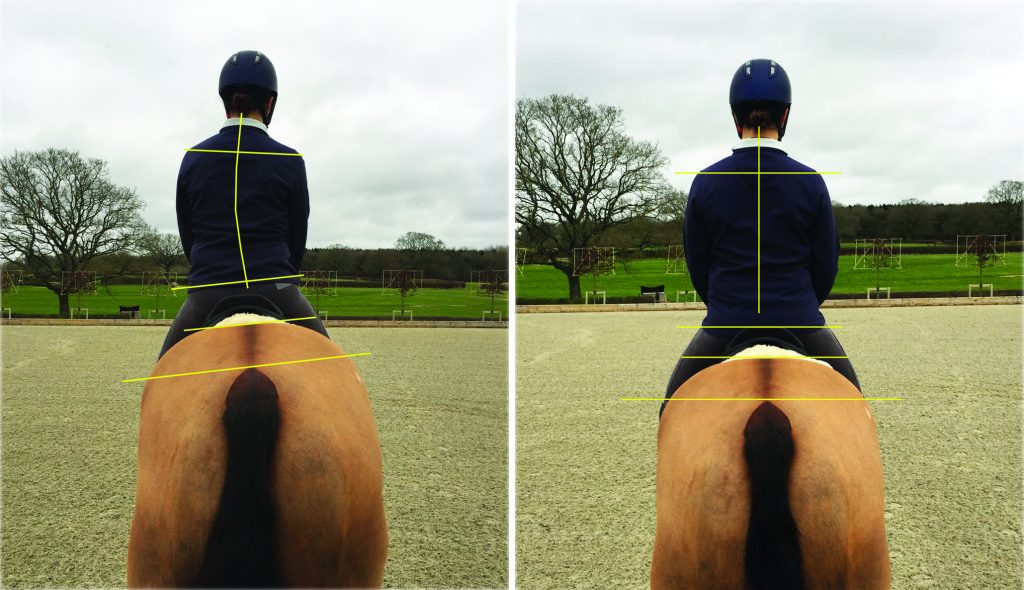
Something as simple as the straightness of the way the rider sits on the horse and how evenly their weight is distributed can have a huge impact on the horse and his enjoyment of ridden work. It also has big implications for the suppleness of horse as if the horse is trying to compensate for imbalance in the rider, then this affects their own ability to work evenly on both reins.
McTimoney Animal Practitioner, Laura Browne has investigated the relationship between horse and rider asymmetry in her peer reviewed research study published in the Equine Veterinary Journal in 2014.
Laura said:
“I chose this topic because I wanted to look at the complete picture of the horse and rider with a focus on the fact that it is a partnership. As riders (both competitive and non-competitive), there is so much more we could do in terms of our strength, suppleness, coordination, and balance to help both ourselves and our horses. We talk about ‘core strength’ a lot for horses but what about for our own core strength? I think this is becoming increasingly recognised in the sport now. But back when I did the research rider fitness, core strength and stability (thus leading to a straight and balanced position in the saddle) was only just being recognised as a factor that really could impact the horse’s performance and risk of injury.”
Laura’s research shows that both riders and horses demonstrate ‘handedness’ meaning one side is favoured over the other resulting in a strong side and a weak side. There is a statistically significant relationship between the two and a positive correlation between a rotation of the rider’s pelvis and that of the horse. This means that in real life, the side of asymmetry in the rider is commonly reflected on the same side of their horse.
Laura added:
“As one pelvis gets worse, so does the other. It is difficult to say whether the horse can give the rider an asymmetric pelvis or vice versa, but the likelihood is that if one half of the horse/rider partnership isn’t straight then there is a high probability of the other half not being straight either.”
Increased awareness and the appropriate schooling can vastly improve this situation, rather than settling for a certain degree of wonkiness and possible discomfort.
Laura continued:
“Pelvis and hind quarter symmetry is key for a horse to use himself correctly. The pelvis is the ‘engine’ of the horse and so identification of asymmetry here is key to improving straightness and levelling out the differences in strong side vs weak side of the horse in question. The research on this asymmetry is limited in the equine industry as it is difficult for us to obtain quantifiable measurements, but it is without doubt that a vast majority of riders will acknowledge the existence of a ‘good rein’ and a ‘bad rein’. It is very important for riders to think about whether the existence of a ‘good rein’ and a ‘bad rein’ is an indication of a more pronounced lack of straightness in both the rider and thus the horse’s pelvis.”
Laura’s study has established that natural asymmetries occur in both horse and rider and with regards to the pelvis they do significantly influence one another. The greater awareness we have of these imbalances the more we can actively do to level them out. The solutions will vary from partnership to partnership but training exercises (such as polework), McTimoney treatment which focusses specifically on identifying asymmetries and promoting straightness (for both horse and rider), rider pilates, saddle fitting, video analysis, and increased knowledge of biomechanics could all be incorporated as possible methods. The aim is to produce a happier and more harmonious horse and rider partnership, with potential for early detection of lameness and reducing long term serious injuries.
There are several simple things that can be done that can increase awareness of both rider and horse symmetry and straightness. Laura suggested:
Ask a friend to video you riding your horse from behind. Ride your horse away from your friend in walk and trot. When you watch the video back, look to see if your hips and shoulders are in alignment with your horse’s pelvis. See too that the right hip bone is the same height as the left one.
The saddle slipping to one side in particular can indicate asymmetry. This could be caused by a number of things including incorrect saddle fit, or girth fit, a crooked horse (that could benefit from McTimoney treatment), an early detection of lameness – or a combination.
Your stirrups can also tell you a fair bit about straightness. Take the stirrup leathers off the saddle, are both leathers a similar length? If the lengths are different then it may be because you constantly put more weight on one side than the other. Another indication here of a lack of straightness is if the leathers are totally even and yet the rider constantly feels as though their stirrups are wonky.
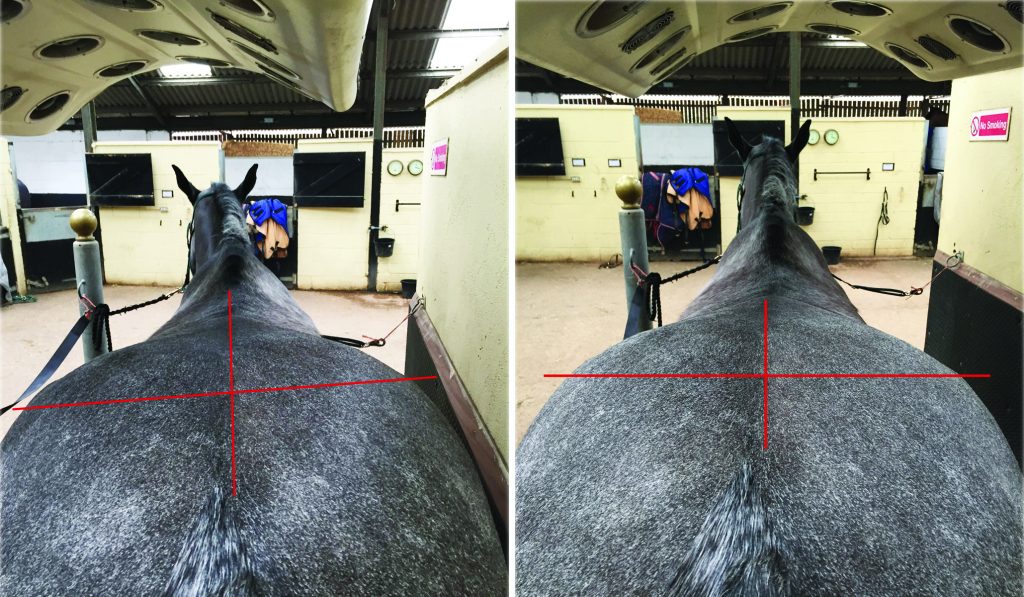
Simply standing your horse up square on a level surface and (carefully) standing behind him to look at the muscle development of the hindquarters can be an interesting exercise and tell you a lot.
All members of the McTimoney Animal Association are qualified after training with the premier institution of its kind, the McTimoney College in Abingdon, having studied up to three years at postgraduate level attaining an MSc or Post Graduate Diploma in Animal Manipulation.
McTimoney Animal Practitioners are registered with the McTimoney Animal Association.
For more information on your local practitioner go to www.mctimoney-animal.org.uk.